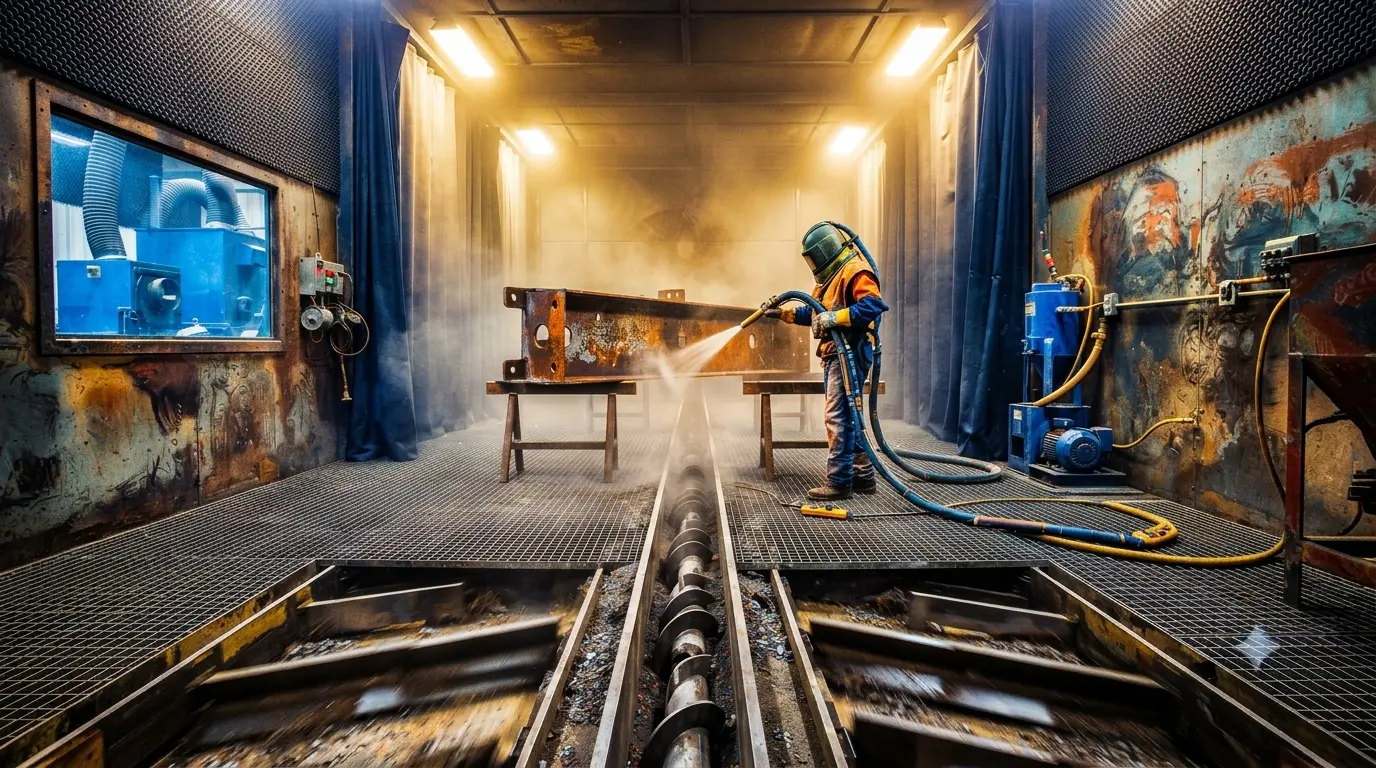
Mechanical Scraper Floor Blast Room: Working, Benefits & Industrial Applications
What happens to the abrasive after blasting a 20-tonne steel structure, railway bogie or wind turbine tower section? In heavy industrial blasting operations, the challenge is not only removing rust and mill scale. It is also collecting the spent abrasive, managing dust and keeping the blasting process moving without unnecessary interruptions.
Manual abrasive collection can become time-consuming when large components require extensive surface preparation. A mechanical scraper floor blast room addresses this challenge through an automated floor recovery arrangement that moves used abrasive towards a recovery and cleaning unit.
For heavy steel fabrication, railway manufacturing and wind turbine production, this system can help reduce manual material handling and improve abrasive management. Understanding its working principle, benefits and recovery options helps industrial buyers select a blast room that matches their production requirements.
What Is a Mechanical Scraper Floor Blast Room?
A mechanical scraper floor blast room is an enclosed abrasive blasting facility equipped with a mechanical system that collects and transports spent abrasive from the floor.
The recovery system uses moving scraper blades or plates to push abrasive towards a collection point. The recovered material is then transferred to a separator, where reusable abrasive is cleaned and returned to the blasting equipment.
A wet blasting machine can also be considered for suitable surface preparation applications. It uses a mixture of water and abrasive media to clean or finish workpieces. However, wet blasting requires a compatible recovery and separation arrangement designed to handle the water, abrasive slurry and removed contaminants.
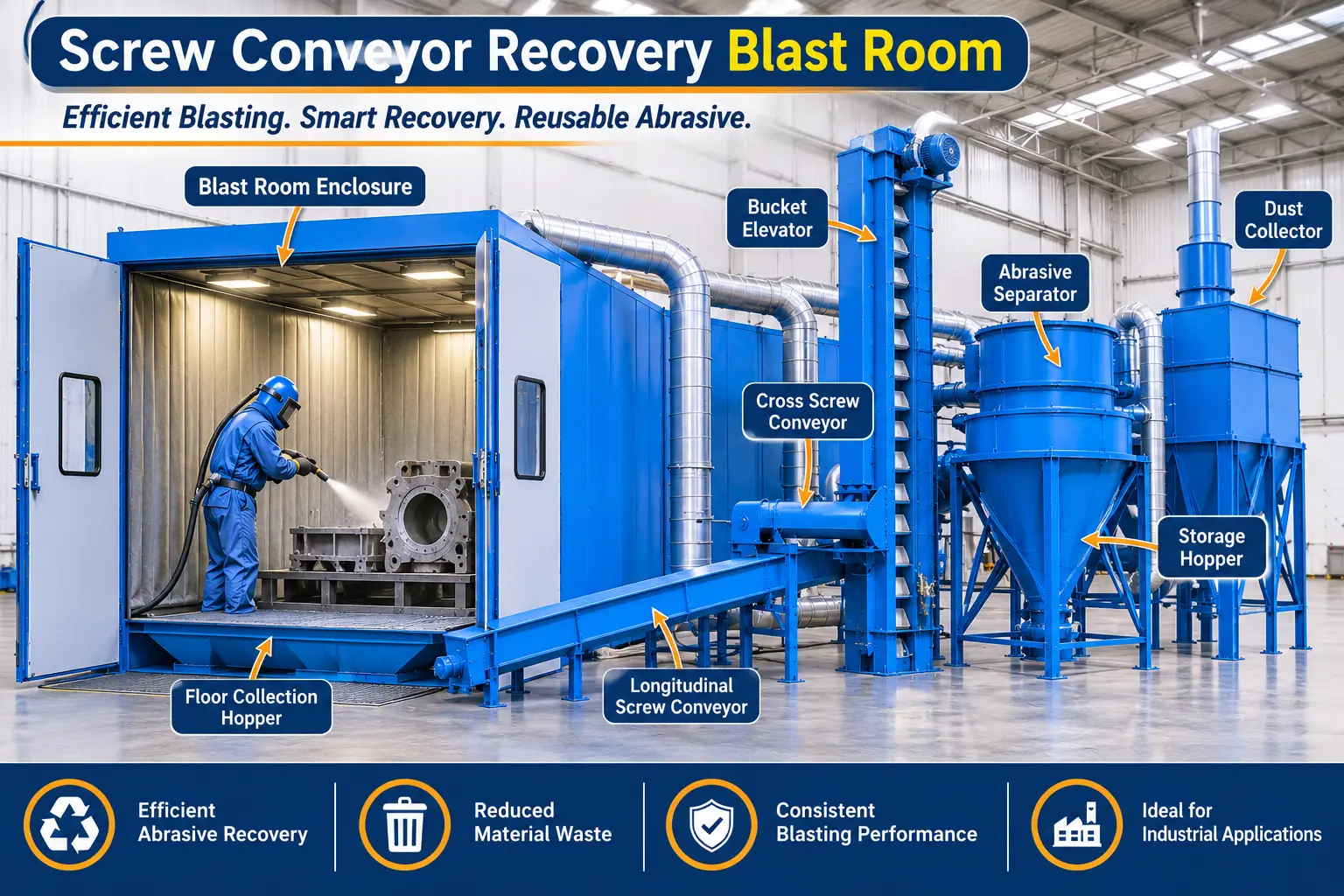
A typical mechanical scraper floor recovery system may include:
- Floor grating and collection channels
- Scraper blades or plates
- Mechanical drive system
- Collection hopper or cross conveyor
- Bucket elevator
- Abrasive separator and storage hopper
- Dust collection system
Depending on the design, a scraper floor can provide partial or full floor abrasive recovery. Some configurations can also reduce the need for deep underground recovery pits.
How Does a Mechanical Scraper Floor Blast Room Work?
Abrasive Blasting Inside the Enclosure
The operator directs plastic abrasive media towards the workpiece using a blasting nozzle. Plastic abrasive media is suitable for applications requiring controlled surface cleaning with minimal damage to the underlying material, such as removing old coatings, paint and surface contaminants from sensitive components.
The blast room enclosure contains the blasting operation and provides a designated working area for industrial surface preparation.
Collection Through the Scraper Floor
After impact, spent abrasive falls through the floor grating into collection channels below.
The grating provides a suitable working surface while allowing abrasive to reach the recovery mechanism. For heavy steel structures and railway components, the floor and supporting structure must be designed for the required loads.
Mechanical Scraping and Abrasive Transport
The scraper mechanism moves through the collection channels, pushing spent abrasive towards the collection point.
Depending on the configuration, the scraper modules may be driven by pneumatic, hydraulic or electric systems. The collected abrasive is transferred to a hopper, cross conveyor or bucket elevator.
Abrasive Cleaning and Separation
The recovered material contains reusable abrasive, dust, broken particles and removed contaminants. It passes through an abrasive cleaning unit that separates unwanted material from reusable media.
Screening and air wash separation may be used, depending on the abrasive type and required cleaning quality. For a portable blast room, the recovery equipment should be selected according to the available space, abrasive consumption and required recovery capacity.
Reuse of Clean Abrasive
Cleaned abrasive is returned to the storage hopper or blasting vessel for reuse. Dust and unwanted material are directed to the dust collection system or appropriate disposal arrangement.
This recovery cycle helps reduce manual abrasive handling and supports regular blasting operations.
Key Components of a Mechanical Scraper Floor Recovery System
| Component | Main Function |
| Blast room enclosure | Contains blasting activities and workpieces |
| Floor grating | Allows abrasive to fall into recovery channels |
| Scraper blades or plates | Move spent abrasive towards the collection point |
| Scraper drive system | Powers the movement of the scraper mechanism |
| Collection hopper | Transfers abrasive towards the recovery equipment |
| Bucket elevator | Lifts abrasive to the separator where required |
| Abrasive separator | Removes dust, fines and unwanted contaminants |
| Dust collector | Captures airborne dust and fine particles |
The components must be matched to room dimensions, abrasive characteristics, workpiece loads and expected production volume.
Benefits of a Mechanical Scraper Floor Blast Room
Automated Abrasive Recovery
A scraper floor can collect abrasive across a designated floor area without relying entirely on manual sweeping. This is useful in larger blasting facilities where spent abrasive can accumulate quickly.
Reduced Manual Material Handling
Mechanical recovery reduces repetitive collection work and can support a more consistent production workflow.
Suitable for Heavy Industrial Components
Scraper floor systems can be designed for suitable heavy duty applications, including steel structures, railway components and large fabricated assemblies. Floor grating and supporting structures must be selected according to workpiece and handling loads.
Flexible Floor Recovery Options
Depending on the application, a scraper floor may be designed for partial or full floor recovery. The required coverage depends on the room layout, abrasive consumption and production requirements.
Improved Abrasive Management
Recovering and cleaning reusable abrasive can reduce unnecessary material losses. Garnet sand is a suitable abrasive for many industrial surface preparation applications, particularly where a clean surface and controlled abrasive profile are required. The recovery system must be designed to handle garnet's particle size, density and durability. Actual savings depend on abrasive consumption, contamination levels, recovery efficiency and operating conditions.
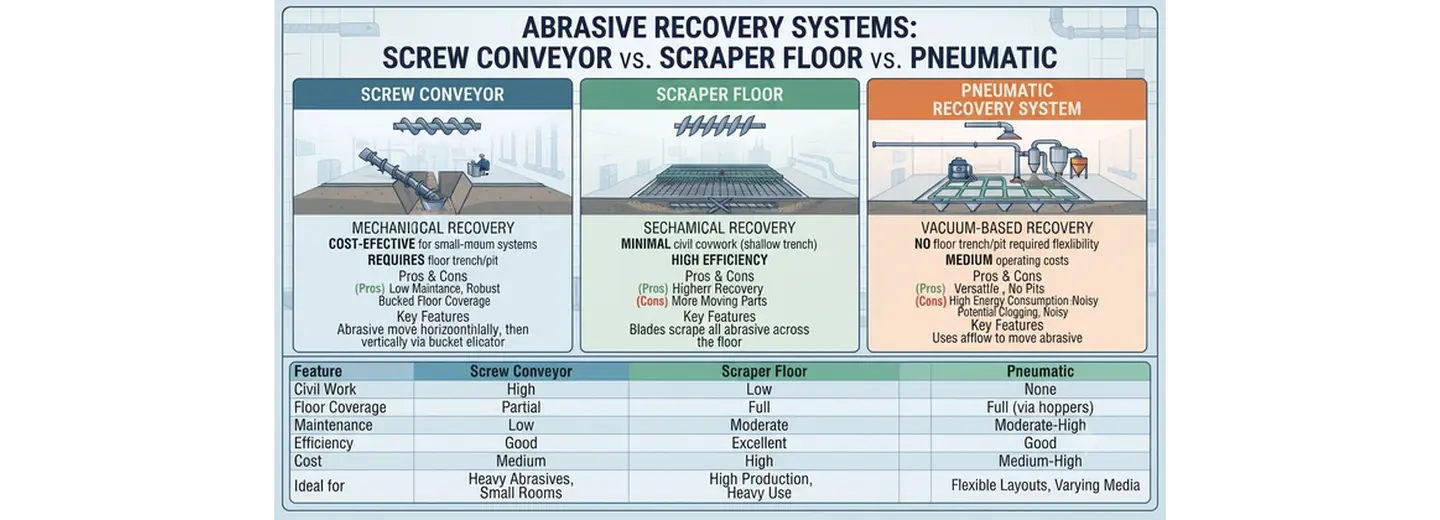
Mechanical Scraper Floor vs. Screw Conveyor vs. Pneumatic Recovery Blast Room
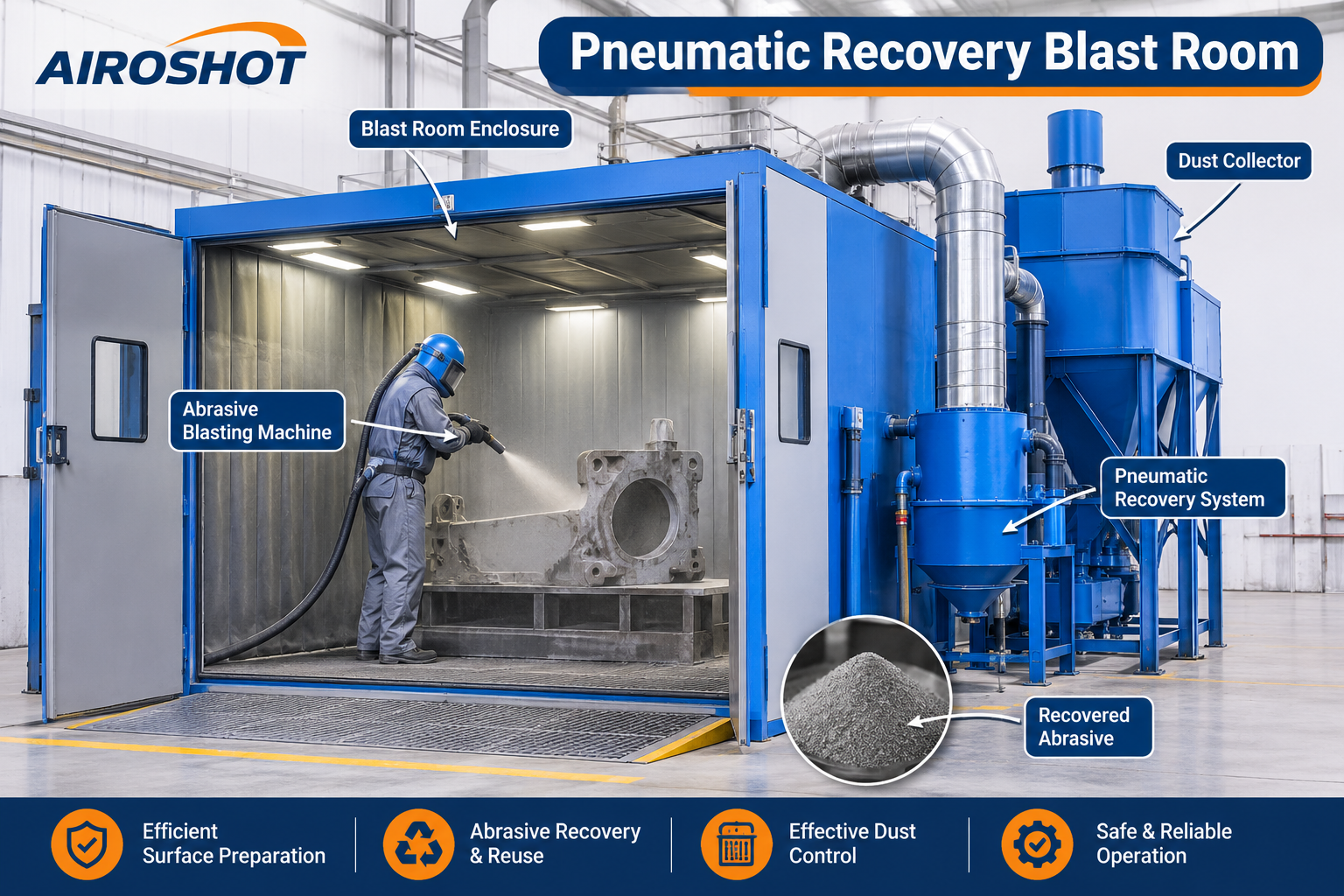
All three systems collect used abrasive and return reusable media to the blasting equipment. Their main difference is how the abrasive is collected and transported.
| Comparison Factor | Mechanical Scraper Floor | Screw Conveyor Recovery | Pneumatic Recovery |
| Recovery mechanism | Moving scraper blades or plates | Rotating screw conveyors | Suction or pneumatic conveying |
| Abrasive collection | Scrapers move abrasive across collection channels | Screws transport abrasive through troughs | Airflow moves compatible abrasive through ducts |
| Floor coverage | Can provide partial or full floor recovery | Usually collects abrasive through designated channels | Depends on suction points and floor arrangement |
| Installation | May use a low profile floor arrangement | Often requires recessed channels or a recovery pit | Can use above ground or low profile arrangements |
| Abrasive compatibility | Depends on scraper and recovery design | Commonly used with suitable metallic abrasives | Depends on abrasive density, particle size and system capacity |
| Recovery capacity | Depends on scraper design and recovery modules | Depends on conveyor and elevator capacity | Depends on airflow and conveying design |
| Maintenance | Scraper blades, drive system and mechanical components | Screws, bearings, drives and bucket elevator | Suction equipment, ducting and filters |
| Main advantage | Broad floor recovery coverage | Controlled mechanical transport | Potentially reduced excavation requirements |
| Main consideration | Floor loading and scraper mechanism | Conveyor layout and mechanical wear | Abrasive compatibility and conveying capacity |
Which Recovery System Should You Choose?
A mechanical scraper floor blast room can be a practical option when abrasive must be collected across a large working area. It may suit heavy steel fabrication, railway manufacturing and wind turbine production when the floor structure and recovery capacity meet the application requirements.
A screw conveyor recovery blast room may be suitable when the facility needs mechanical abrasive transport through designated floor channels.
A pneumatic recovery blast room may be worth evaluating when excavation is restricted or a suitable above-ground recovery arrangement is required.
A suction blast room uses a pneumatic recovery system to collect spent abrasive through suction points or designated collection channels. The recovered material is transferred to a recovery unit for cleaning and separation. This option may suit facilities requiring flexible abrasive collection without conventional mechanical conveyors.
The final selection should consider abrasive type, recovery capacity, floor layout, workpiece handling requirements and total installation and operating costs.
Applications of Mechanical Scraper Floor Blast Rooms
Heavy Steel Structure Manufacturing
Steel fabrication facilities process large beams, girders, plates and fabricated structures that require surface preparation before protective coating.
A mechanical scraper floor blast room can help manage abrasive recovery across large working areas. It is particularly relevant when frequent blasting creates substantial abrasive accumulation.
Railway Manufacturing and Maintenance
Railway manufacturing and refurbishment may involve blasting bogies, underframes, wagon components and other large metal structures.
A scraper floor recovery system can support regular abrasive collection in suitable railway blasting facilities. The room dimensions, floor loading capacity and recovery layout should match the components being processed.
Wind Turbine Tower Manufacturing
Wind turbine production involves large steel tower sections and fabricated components that require surface preparation before coating.
A custom engineered blast room can be designed to accommodate these components while a mechanical scraper floor helps collect spent abrasive from the working area. The room configuration can be tailored to the required component dimensions, production capacity and abrasive recovery requirements.
For long tower sections, the recovery layout should be planned alongside the room length, component movement and loading arrangement.
Heavy Engineering and Industrial Maintenance
Large machinery, industrial equipment and fabricated assemblies may require abrasive blasting during manufacturing or refurbishment.
A mechanical scraper floor can be considered where regular abrasive recovery and reduced manual collection are important.
How to Choose the Right Mechanical Scraper Floor Blast Room
Before selecting a mechanical scraper floor blast room, evaluate these factors:
- Workpiece dimensions: Confirm the maximum length, width, height and weight of the components to be blasted.
- Floor load capacity: Check whether the grating and supporting structure can handle the required component and handling loads.
- Recovery coverage: Determine whether partial-floor or full-floor recovery is suitable for the blasting operation.
- Abrasive compatibility: Confirm that the scraper mechanism and recovery equipment are suitable for the selected abrasive type, including glass beads, and its particle size. Glass beads are commonly used for applications requiring a smooth surface finish and controlled surface treatment. Ensure the recovery system is designed to handle their size, shape and fragility without excessive breakage.
- Recovery capacity: Match the system capacity to abrasive consumption and the expected production workload.
- Installation requirements: Review foundation depth, floor arrangement, equipment access and component movement.
- Maintenance access: Provide sufficient space to inspect scraper blades, drive mechanisms, conveyors and abrasive cleaning equipment.
Explore Mechanical Scraper Floor Blast Room Solutions from BLASTROOMS
Selecting a suitable blast room involves more than choosing a floor recovery mechanism. The enclosure, blasting equipment, abrasive recovery system, dust collection arrangement and workpiece handling equipment must function together.
BLASTROOMS provides industrial shot blasting machine, abrasive blasting equipment solutions for surface preparation applications. Businesses planning a mechanical scraper floor blast room can evaluate their workpiece dimensions, production requirements, abrasive type and installation conditions before finalizing a suitable configuration.
For a project-specific recommendation, discuss your application requirements with the BLASTROOMS team and request a quotation for a suitable blast room solution.
Conclusion
A mechanical scraper floor blast room can be a practical solution for industrial blasting operations that require regular abrasive recovery across a large working area.
Its automated scraping mechanism can help reduce manual material handling and support abrasive reuse in suitable heavy steel, railway, wind turbine and heavy engineering applications.
The best configuration depends on workpiece dimensions, floor loading, abrasive type, recovery coverage and installation requirements. A proper technical assessment helps ensure that the selected blast room matches the actual production needs of the facility.