Product Gallery

Product Gallery
Industrial surface preparation application use-case.
Industrial surface preparation application use-case.
Industrial surface preparation application use-case.
Industrial surface preparation application use-case.
Industrial surface preparation application use-case.
Industrial surface preparation application use-case.
Product Overview
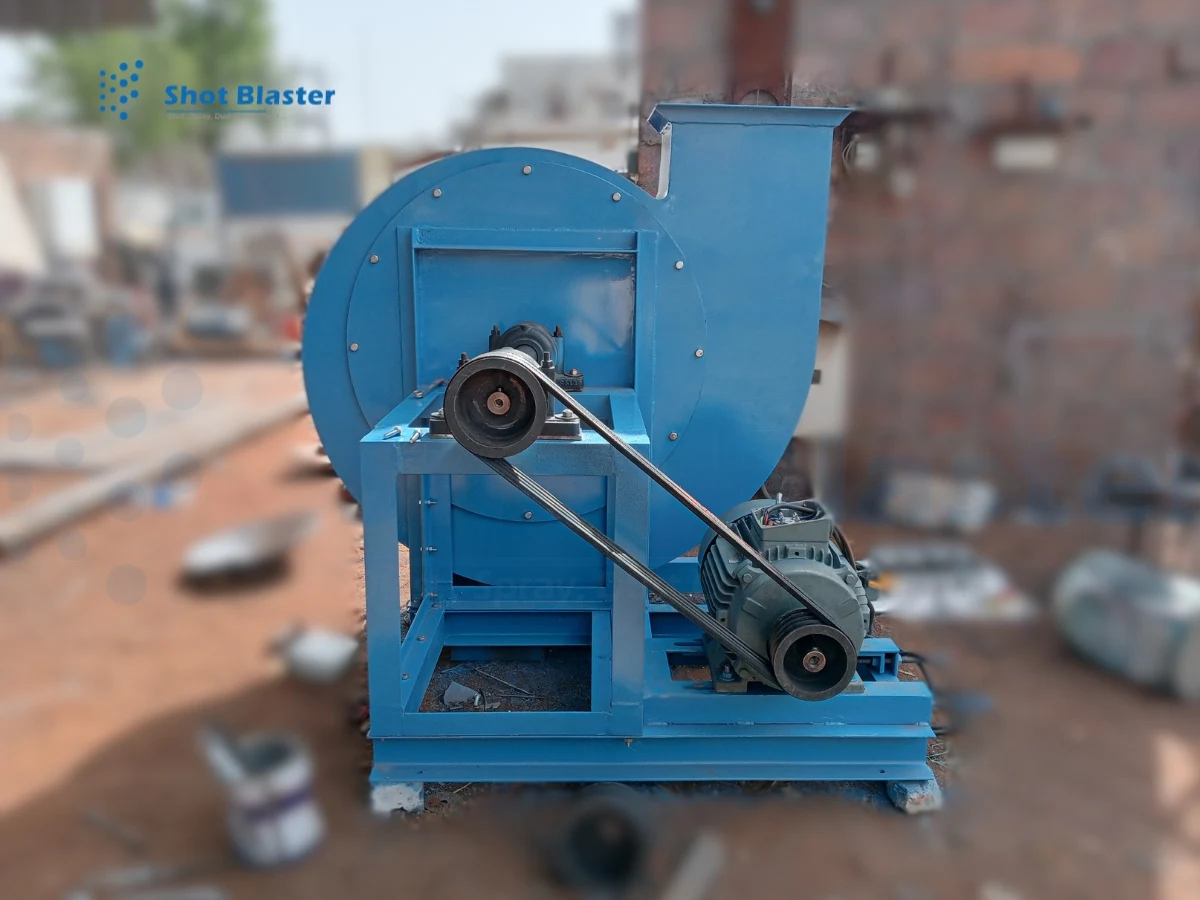
Centrifugal fans are very efficient and versatile piece of air moving equipment. Centrifugal fans contain centrifugal fan blower with a centrifugal fan impeller and scroll housing and that housing accelerate the air and changes the direction of airflow two times, a full 90 degree before leaving the house. They are reliable and made in a way so that they can operate in a variety of environments and applications.
Centrifugal fan blade:
1. Radial:
The pressure of these fans is high and medium airflow. These fans are used when there is gas or moisture in the air.
2. Forward curve:
The pressure is medium and airflow is high and they are used in the cleaning of air, ventilation, and exhaust applications.
3. Backward curve:
These fans have high pressure, high efficiency, and high flow, and when power is reduced the flow rate will increase.
4. Airfoil:
These fans are used for cleaning the air and the efficiency of these fans are high.
To choose the correct fan we should have complete knowledge about the pressure requirement. When we have a more complicated and lengthy duct system then its power requirements are also high. Usually, we have two drive system in centrifugal fan which are:
Direct Drive: direct drive system mainly used for smaller blowers and also offer lower cost with reduced maintenance and greater reliability.
Belt Drive: belt drive has uses in the application of large blowers when they are equipped with a variable frequency drive.
Centrifugal fan efficiency is the ratio between power transferred to airflow and the power used by the fan.
Motor efficiency used:
Mainly we have 8 types of impeller wheels which are:
1) Shrouded radial wheel
2) Open radial blade
3) Open paddle wheel
4) Backward inclined
5) Airfoil blade
6) Forward curved multi-vane
7) Backward curved radial
| Centrifugal fan | Axial fan |
| Flow of air is radially | Flow of air in the axial direction |
| Airflow is directed through a system of ducts or tubes | Create a large volume of airflow |
| Power input is high | Low power input |
| High pressure airflow | Low pressure airflow |
| Flow rate is low | High flow rate |
Blast Rooms are the manufacturer of all kind of Sand Blasting machine and Blasting cabinet. we also manufacture different blasting machine-like Shot Blasting Machine and Grit Blasting Machine. Rather than blasting machines we also manufacture coating equipment such as Thermal Spray Gun on-demand. we also supply all types of Abrasive Media at the best price and with great quality assurance.
Get quick answers to common technical and commercial questions before selecting the right centrifugal fan configuration.
These FAQs help engineering and procurement teams evaluate process fit, operating requirements, and long-term support clarity.
A blast room is an enclosed chamber where abrasive blasting is performed under controlled conditions to remove rust, scale, and contaminants before coating or finishing. It improves consistency, safety, and productivity for industrial surface preparation.
A sand blasting room contains dust, recovers abrasive media, and provides controlled airflow, which improves operator safety and process quality compared with open blasting. It also reduces media wastage and environmental exposure.
Common options include steel grit, steel shot, aluminum oxide, garnet, and glass beads. The right abrasive media depends on substrate type, required surface profile, and coating specification.
Yes. Blast room systems can be engineered for your part dimensions, throughput targets, recovery configuration, dust collection capacity, and automation level to match your application.
Pricing is influenced by chamber size, conveyor or handling system, abrasive recovery design, dust collector capacity, automation scope, and compliance requirements. A technical assessment helps determine the right configuration and budget.
Share your requirement and get a technical-commercial proposal tailored to your process, capacity, and site setup.